One District One Product (ODOP): Complete Guide to Objectives, Benefits, Eligibility, Financial Assistance & Implementation
Introduction to One District One Product (ODOP)
India is known for its rich cultural heritage, traditional craftsmanship, agricultural diversity, and unique local products. Every district in the country has its own specialty—whether it is handicrafts, handloom products, food processing items, agricultural produce, spices, textiles, or indigenous art forms. However, many of these traditional products and local industries face challenges such as limited market access, inadequate infrastructure, lack of branding, outdated production techniques, and insufficient financial support. These issues often prevent local producers and artisans from realizing the full economic potential of their products.
To unlock the potential of district-specific products and promote balanced regional development, the Government of India introduced the One District One Product (ODOP) initiative. The programme focuses on identifying a unique product from each district and providing comprehensive support through skill development, financial assistance, infrastructure, branding, marketing, quality improvement, and export promotion.
The ODOP initiative encourages local entrepreneurship, strengthens Micro, Small and Medium Enterprises (MSMEs), promotes value addition, supports farmers and artisans, and generates employment opportunities across rural and urban India. It also complements several flagship government programmes, including PM Formalisation of Micro Food Processing Enterprises (PMFME), Startup India, Make in India, Atmanirbhar Bharat, Skill India Mission, and Vocal for Local.
In this comprehensive guide, we will explore everything about the One District One Product (ODOP) initiative, including its objectives, features, benefits, eligibility, implementation process, financial support, and its role in strengthening India’s local economy.
What is One District One Product (ODOP)?
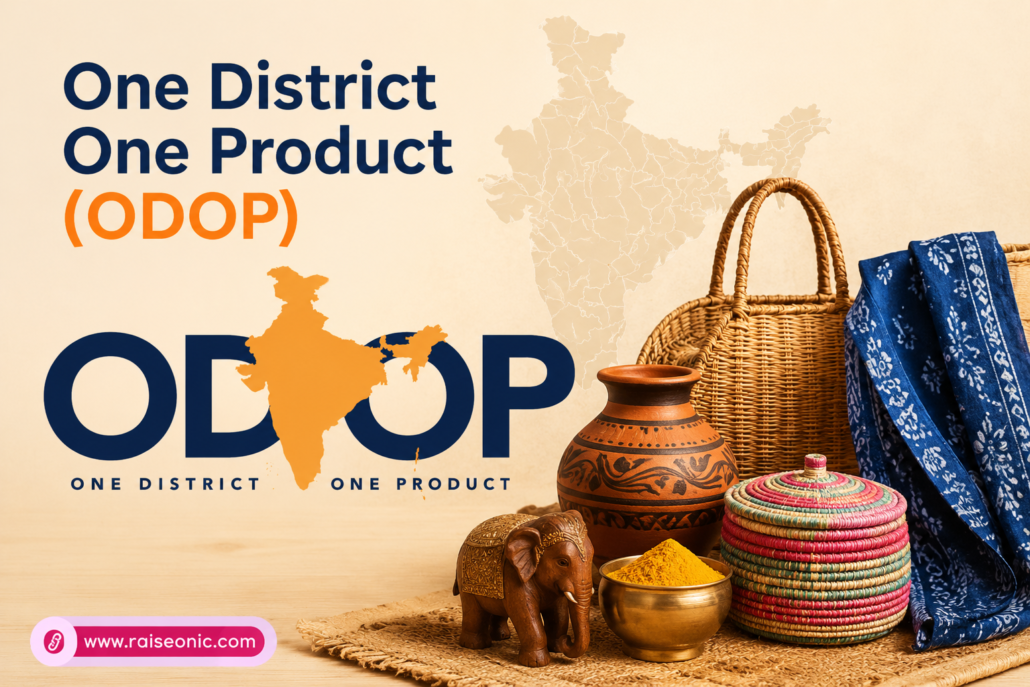
One District One Product (ODOP) is a Government of India initiative aimed at promoting the balanced development of districts by identifying and supporting products that have unique local importance and high economic potential.
The initiative focuses on developing complete value chains for district-specific products by improving production, processing, branding, packaging, quality standards, marketing, exports, and infrastructure.
Unlike a standalone financial assistance scheme, ODOP serves as a development framework that integrates multiple government programmes and support mechanisms to strengthen district-level industries.
Under the PM Formalisation of Micro Food Processing Enterprises (PMFME) Scheme, the ODOP approach plays a significant role in promoting food processing industries by identifying one major food product for each district and supporting enterprises engaged in its production and processing.
The initiative covers various sectors such as:
- Agriculture
- Food Processing
- Handloom
- Handicrafts
- Textiles
- Bamboo Products
- Leather Goods
- Fisheries
- Dairy Products
- Spices
- Horticulture
- Traditional Art and Craft
Why Was the ODOP Initiative Introduced?
Although India produces a wide variety of agricultural products and traditional goods, many local industries remain underdeveloped due to several challenges.
Some common issues include:
- Limited branding and packaging
- Low productivity
- Poor market access
- Lack of modern technology
- Limited export opportunities
- Inadequate infrastructure
- Difficulty accessing finance
- Weak value chains
The Government introduced the ODOP initiative to address these issues by developing district-level specialization and strengthening local economies.
The initiative also supports national priorities such as:
- Atmanirbhar Bharat
- Vocal for Local
- Make in India
- Startup India Initiative
- PMFME Scheme
- Doubling Farmers’ Income
- Export Promotion
Objectives of One District One Product (ODOP)
The initiative has several important objectives.
1. Promote District-Level Specialization
The primary objective is to identify and promote products that represent the unique strengths of each district.
2. Strengthen Local Industries
ODOP supports artisans, farmers, entrepreneurs, and MSMEs engaged in district-specific products.
3. Improve Value Addition
The initiative encourages processing, packaging, branding, and quality improvement to increase product value.
4. Generate Employment
By strengthening local industries, ODOP creates employment opportunities in both rural and urban areas.
5. Increase Exports
The initiative helps local products meet national and international quality standards, improving export potential.
6. Encourage Entrepreneurship
ODOP promotes new business opportunities based on district-specific resources and traditional skills.
Key Features of One District One Product (ODOP)
Identification of District-Specific Products
Each district identifies one product based on factors such as:
- Local availability
- Traditional expertise
- Market demand
- Employment potential
- Export opportunities
Cluster-Based Development
The initiative promotes cluster development by bringing together producers, processors, entrepreneurs, and supporting institutions.
Infrastructure Development
Support may include:
- Common processing facilities
- Storage infrastructure
- Packaging units
- Cold chain facilities
- Quality testing laboratories
Branding and Marketing Support
ODOP encourages:
- Product branding
- Attractive packaging
- Digital marketing
- Trade fairs
- E-commerce participation
- Domestic and international exhibitions
Skill Development
Entrepreneurs, artisans, and workers receive training in:
- Modern production techniques
- Quality control
- Packaging
- Food safety (where applicable)
- Business management
- Marketing
Convergence with Government Schemes
ODOP works alongside several government initiatives, including:
- PM Formalisation of Micro Food Processing Enterprises (PMFME)
- Startup India Initiative
- Pradhan Mantri Mudra Yojana
- Stand-Up India Scheme
- Skill India Mission
- Digital India
- National Rural Livelihood Mission (NRLM)
Benefits of One District One Product (ODOP)
1. Promotes Local Entrepreneurship
ODOP creates business opportunities based on local resources and traditional expertise.
2. Improves Product Quality
Training and modern technology help producers manufacture higher-quality products.
3. Enhances Market Access
Entrepreneurs receive support for branding, packaging, marketing, and participation in exhibitions.
4. Encourages Export Growth
District products gain better access to international markets through improved quality standards and promotion.
5. Generates Employment
Expansion of district industries creates jobs for local youth, women, artisans, and farmers.
6. Increases Farmers’ Income
Value addition and better market linkages improve returns for agricultural producers.
7. Preserves Traditional Skills
The initiative helps protect India’s cultural heritage by promoting traditional crafts and indigenous products.
Eligibility Criteria
Eligibility depends on the specific scheme or programme implemented under the ODOP framework. Generally, beneficiaries may include:
- Individual entrepreneurs
- Existing MSMEs
- Micro food processing enterprises
- Farmer Producer Organizations (FPOs)
- Self Help Groups (SHGs)
- Producer Cooperatives
- Artisan groups
- Startups
- Farmers
- Women’s enterprises
Applicants should satisfy the eligibility criteria prescribed under the relevant implementing scheme.
Documents Required
The required documents vary depending on the specific programme. Generally, applicants may need:
- Aadhaar Card
- PAN Card
- Passport-size photographs
- Address proof
- Business registration documents (if applicable)
- Udyam Registration (where applicable)
- Bank account details
- Project report
- Quotations for machinery (where applicable)
- Product-related documents
- Any additional documents required under the respective scheme
How to Apply for One District One Product (ODOP)
Since ODOP is implemented through various government departments and schemes, the application process differs depending on the type of support being sought.
Generally, the process includes:
Step 1: Identify Your District Product
Check whether your business is associated with the notified ODOP product of your district.
Step 2: Select the Appropriate Government Scheme
Choose the relevant scheme offering financial or technical support, such as PMFME or other state-specific ODOP programmes.
Step 3: Prepare a Business Proposal
Develop a project report detailing production plans, investment requirements, marketing strategy, and expected outcomes.
Step 4: Submit the Application
Apply through the designated portal or implementing agency responsible for the selected scheme.
Step 5: Verification
Authorities evaluate the application and verify the submitted documents.
Step 6: Approval and Assistance
Eligible applicants receive financial assistance, training, infrastructure support, or other benefits according to the applicable programme guidelines.
Who Can Benefit from One District One Product (ODOP)?
The initiative benefits a wide range of stakeholders, including:
- Farmers
- Food processing entrepreneurs
- MSMEs
- Rural entrepreneurs
- Women entrepreneurs
- Self Help Groups (SHGs)
- Farmer Producer Organizations (FPOs)
- Artisan groups
- Handloom workers
- Handicraft manufacturers
- Startup founders
- Export-oriented businesses
Impact of One District One Product (ODOP)
The ODOP initiative has significantly strengthened district-level economic development by:
- Promoting local products and traditional industries.
- Improving branding and packaging.
- Increasing market access.
- Supporting value addition.
- Encouraging entrepreneurship.
- Creating employment opportunities.
- Enhancing exports of district-specific products.
- Strengthening rural economies.
The initiative continues to play an important role in promoting inclusive and sustainable economic growth across India.
Challenges and Future Opportunities
Although ODOP has achieved considerable success, several opportunities remain for further improvement.
Expanding Digital Marketing
Greater use of e-commerce platforms can increase product visibility and sales.
Strengthening Export Networks
Improved international branding and export facilitation can help local products reach global markets.
Technology Adoption
Modern machinery and digital technologies can improve productivity and product quality.
Better Infrastructure
Continued investment in logistics, storage, testing laboratories, and common facility centres will strengthen district value chains.
With sustained government support and industry participation, ODOP has the potential to transform district economies across the country.
How One District One Product (ODOP) Supports India’s Vision
The initiative contributes directly to several flagship government programmes, including:
- PM Formalisation of Micro Food Processing Enterprises (PMFME)
- Startup India Initiative
- Pradhan Mantri Mudra Yojana
- Stand-Up India Scheme
- Skill India Mission
- Make in India
- Digital India
- Atmanirbhar Bharat
- Vocal for Local
Together, these initiatives promote entrepreneurship, innovation, local manufacturing, employment generation, and sustainable economic development.
How Raiseonic Helps Entrepreneurs Stay Updated
Government programmes supporting MSMEs, startups, agriculture, food processing, exports, and entrepreneurship continue to evolve with new policies, financial assistance, and business opportunities.
At Raiseonic, we simplify government schemes by providing easy-to-understand guides, practical insights, and expert information on startup funding, MSME initiatives, food processing programmes, business loans, women entrepreneurship schemes, agricultural development, and financial assistance programmes.
Whether you are a farmer, artisan, entrepreneur, startup founder, or MSME owner, Raiseonic helps you stay informed about government opportunities that can accelerate your business growth.
Conclusion
The One District One Product (ODOP) initiative is a transformative step towards strengthening India’s local economy by promoting district-specific products, supporting entrepreneurs, and preserving traditional industries. By focusing on value addition, branding, market access, infrastructure development, and skill enhancement, ODOP creates new opportunities for farmers, artisans, MSMEs, and startups while contributing to employment generation and export growth.
As India continues its journey toward becoming a self-reliant and globally competitive economy, the ODOP initiative will remain a key driver of inclusive regional development and sustainable entrepreneurship. Entrepreneurs associated with district-specific products should explore the various government schemes and support mechanisms available under the ODOP framework to maximize their growth potential.
For the latest updates on government schemes, MSME programmes, startup initiatives, agricultural policies, women entrepreneurship schemes, food processing support, and business financing opportunities, stay connected with Raiseonic—your trusted source for simplified government scheme information and guidance.

