
Tag Archive for: startup funding Tamil Nadu

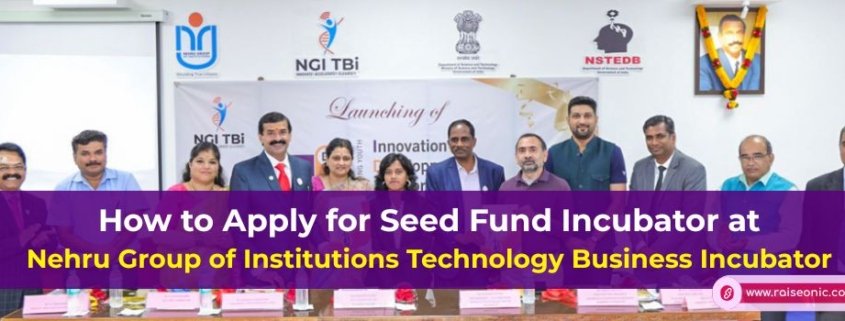
NGI TBI

Introduction

In a world where innovation drives economic growth, the need for strong startup support systems has never been greater. India’s startup ecosystem has witnessed tremendous growth — but every idea still needs the right launchpad to take flight.

That’s where the Nehru Group of Institutions Technology Business Incubator (NGI TBI) steps in — a state-of-the-art innovation hub designed to nurture early-stage entrepreneurs and help them convert ideas into sustainable ventures.

Supported by the Atal Innovation Mission (AIM) under NITI Aayog, NGI TBI offers seed funding, mentorship, research infrastructure, and incubation facilities to startups across technology, agriculture, health, and manufacturing sectors.

If you’re a startup founder with a scalable, innovative idea, this detailed guide will walk you through how to apply for the NGI TBI Seed Fund, its eligibility criteria, application process, and benefits.


💡 1. About NGI TBI – Nehru Group of Institutions Technology Business Incubator

Founded under the Atal Innovation Mission (AIM), the NGI Technology Business Incubator (NGI TBI) is an initiative of the Nehru Group of Institutions, based in Coimbatore, Tamil Nadu.

NGI has a long-standing reputation in higher education, research, and innovation, and the TBI was established to extend that legacy into entrepreneurship and industrial growth.

🔬 Vision

To create a vibrant innovation ecosystem that empowers young entrepreneurs to build sustainable, technology-driven businesses capable of creating employment and societal impact.

🎯 Mission

To nurture startups through funding, mentorship, prototyping support, and networking— transforming raw ideas into market-ready products and solutions.


⚙️ 2. The NGI TBI Seed Fund Program

The NGI TBI Seed Fund Program is implemented under the Startup India Seed Fund Scheme (SISFS) — a Government of India initiative by the Department for Promotion of Industry and Internal Trade (DPIIT).

This program provides financial assistance and incubation support to early-stage startups that have an innovative concept but lack initial funding to develop and validate their business model.

💰 Funding Structure:

  • Prototype/Proof-of-Concept Grant: Up to ₹20 Lakhs

  • Market Entry/Commercialization Funding: Up to ₹50 Lakhs (as debt or convertible instruments)

🧭 Objective:

To help startups move from idea validation to market entry by supporting them through prototype development, testing, and commercialization.


🧩 3. Focus Areas of NGI TBI

NGI TBI supports startups in a wide range of innovation domains, including:

  • Artificial Intelligence & Machine Learning

  • Internet of Things (IoT)

  • Clean Energy & Renewable Technologies

  • AgriTech and Food Processing

  • EdTech and HealthTech

  • Manufacturing & Automation

  • Biotechnology and Life Sciences

  • Waste Management and Sustainability

This multi-sector approach makes NGI TBI one of South India’s most inclusive incubation centers.


🧠 4. Eligibility Criteria for Applying to NGI TBI Seed Fund

To ensure that only truly innovative and growth-oriented startups benefit, NGI TBI follows the Startup India Seed Fund Scheme (SISFS) eligibility norms along with its own evaluation framework.

General Eligibility

  1. The startup must be DPIIT-recognized under the Startup India initiative.

  2. It must be incorporated as a Private Limited Company, LLP, or Partnership Firm in India.

  3. The startup should be less than 10 years old from the date of incorporation.

  4. Annual turnover should not exceed ₹100 crore in any financial year.

  5. The startup should have 51% Indian ownership at the time of application.

  6. It should not have received more than ₹10 lakh in grants from other government programs for the same project.

🧬 Additional Criteria

  • The idea should demonstrate novelty, innovation, and scalability potential.

  • Preference is given to startups focusing on sustainability and social impact.

  • Startups with working prototypes or MVPs are prioritized for higher funding.


🧾 5. Step-by-Step Guide: How to Apply for the NGI TBI Seed Fund

The application process for NGI TBI is designed to be simple, transparent, and fully online.

🪜 Step 1: Apply via Startup India Seed Fund Portal

Visit the Startup India Seed Fund Scheme (SISFS) website and choose NGI TBI as your preferred incubator.

🖱️ Apply Here – Startup India SISFS Portal

🪜 Step 2: Complete the Application Form

You will need to fill in details such as:

  • Startup name and sector

  • Problem statement and innovative solution

  • Prototype or MVP status

  • Target market and scalability potential

  • Business model and revenue plan

  • Fund requirement and utilization plan

🪜 Step 3: Upload Supporting Documents

Attach the following:

  • DPIIT certificate

  • Incorporation/Registration document

  • Detailed business plan and financial projections

  • Founder KYC documents

  • Pitch deck and proof of innovation

🪜 Step 4: Application Review

NGI TBI’s Seed Fund Evaluation Committee (SFEC) reviews the applications on innovation, technical viability, and team strength.

🪜 Step 5: Pitch Presentation

Shortlisted startups will present their idea to a panel of mentors, investors, and domain experts from NGI’s ecosystem.

🪜 Step 6: Selection and Onboarding

Selected startups receive seed funding in tranches linked to milestones such as prototype completion, pilot validation, and product launch.

They are also inducted into NGI’s incubation program for mentorship and capacity-building support.


🧰 6. Benefits of Getting Incubated at NGI TBI

The value of NGI TBI goes far beyond just funding — it provides end-to-end ecosystem support.

💡 1. Seed Funding Support

Receive up to ₹50 lakh in funding for product development, testing, and early commercialization.

🧭 2. Mentorship Access

NGI TBI provides direct mentorship from industry experts, entrepreneurs, and academic leaders from Nehru Group institutions.

🧪 3. Infrastructure and Labs

Startups gain access to R&D labs, fabrication facilities, coworking spaces, and product testing infrastructure.

🌍 4. Networking and Investor Connect

Regular demo days, pitch sessions, and industry meets connect founders with angel investors, venture capitalists, and government agencies.

🧑‍💼 5. Capacity Building Programs

Workshops on IP filing, regulatory compliance, marketing, and financial management are organized regularly.

🤝 6. Corporate Collaboration

Startups get access to NGI’s corporate and industrial partnerships for pilot projects and commercial tie-ups.


🔍 7. Evaluation Criteria

Applications are assessed using a transparent, merit-based evaluation system based on the following parameters:

Parameter Evaluation Aspect
Innovation Uniqueness of technology or approach
Feasibility Technical and operational viability
Market Potential Target market and revenue potential
Impact Social, environmental, or economic benefits
Team Competence Skills, experience, and execution capability
Scalability Growth and expansion prospects

🏆 8. Success Stories and Impact

NGI TBI has supported multiple startups that have gone on to achieve market validation, funding, and recognition. Some examples include:

  • AgroTech Innovators: Developing smart irrigation systems that reduce water usage.

  • BioPure: Innovating biodegradable packaging solutions for the food industry.

  • NextGen Automation: Building cost-effective robotic arms for SMEs.

These success stories show how NGI TBI bridges academia, industry, and entrepreneurship to create a thriving startup ecosystem in South India.


📞 9. Contact Information

📍 Address:
Nehru Group of Institutions – Technology Business Incubator (NGI TBI)
Nehru College Campus, Thirumalayampalayam, Coimbatore, Tamil Nadu – 641105

📧 Email: info@ngitbi.org
🌐 Website: www.ngitbi.org
📞 Phone: +91 422 236 3800


🌱 10. Conclusion

The Nehru Group of Institutions Technology Business Incubator (NGI TBI) represents the future of innovation-led entrepreneurship in India.

By combining funding, mentorship, and technical infrastructure, NGI TBI is enabling startups to not just survive, but thrive — transforming bold ideas into profitable, impactful ventures.

Whether you are working on IoT-based agriculture, AI-driven automation, or biotech innovations, NGI TBI provides the perfect launchpad to take your startup from concept to commercialization.

Apply today for the NGI TBI Seed Fund and join an ecosystem built for innovation, collaboration, and success.

Sona Incubation Foundation

Introduction

In India’s rapidly expanding startup ecosystem, innovation isn’t confined to metropolitan cities anymore. Emerging hubs like Tamil Nadu are leading the way in fostering entrepreneurial talent through academic institutions and technology incubators. Among the key players in this ecosystem is the Sona Incubation Foundation (SIF) — a dedicated startup incubator supported by the Sona College of Technology, Salem.

Sona Incubation Foundation plays a vital role in helping student innovators, early-stage founders, and technology entrepreneurs transform their ideas into viable businesses. Through its participation in the Startup India Seed Fund Scheme (SISFS), SIF offers financial assistance, mentorship, and infrastructure support to startups working on innovative and scalable ideas.

This guide explores how aspiring founders can apply for the Seed Fund Incubation Program at Sona Incubation Foundation, including eligibility criteria, application process, and the unique benefits the incubator provides.

1. About Sona Incubation Foundation

The Sona Incubation Foundation (SIF) was established under the aegis of Sona College of Technology, one of Tamil Nadu’s most prestigious engineering institutions. It is recognized by the Department for Promotion of Industry and Internal Trade (DPIIT) and supported by the Atal Innovation Mission and Startup India Seed Fund Scheme (SISFS).

SIF’s mission is to create a strong entrepreneurial culture among students, researchers, and innovators by providing access to the right ecosystem — funding, mentorship, technology support, and market access.

With its multidisciplinary approach and strong ties with industry, academia, and government, SIF has become a preferred incubation center for startups in domains like engineering, manufacturing, healthcare, agri-tech, renewable energy, and education technology.

2. Understanding the Seed Fund Program

Sona Incubation Foundation administers the Startup India Seed Fund Scheme (SISFS) to help startups bridge the crucial funding gap between ideation and commercialization.

The program provides early-stage financial assistance for:

  • Proof of Concept (PoC)

  • Prototype Development

  • Product Trials

  • Market Entry

  • Commercialization

Funding Support Offered:

  1. Grant of up to ₹20 lakhs:
    For product development, prototype testing, and validation.

  2. Debt/Convertible Debentures up to ₹50 lakhs:
    For market expansion, commercialization, and scaling activities.

The funding is milestone-based and disbursed after successful evaluation and approval by the incubator’s Seed Fund Management Committee (SFMC).

3. Eligibility Criteria

Startups interested in applying for the seed fund at Sona Incubation Foundation must meet the following DPIIT and SISFS criteria:

  • Startup Recognition: The startup must be recognized by DPIIT under the Startup India initiative.

  • Incorporation Type: Must be registered as a Private Limited Company, LLP, or Partnership Firm in India.

  • Age of Startup: The startup should not be older than 10 years from its date of incorporation.

  • Turnover Limit: Should not have exceeded ₹100 crores in any financial year since incorporation.

  • Innovation Focus: The startup should be working towards developing or improving a product, process, or service with a scalable business model.

  • Ownership: At least 51% shareholding should be held by Indian promoters.

  • Stage: Ideally, startups should be at the prototype or early traction stage, with potential for commercialization.

Startups from academic backgrounds, student projects, and research labs are also encouraged to apply if they can demonstrate commercial potential.

4. Application Process

Applying for the Seed Fund Program at Sona Incubation Foundation is simple but requires careful preparation. Follow the steps below:

Step 1: Register on Startup India Portal

Create your startup profile and obtain DPIIT recognition by submitting details such as your business structure, innovation summary, and financial projections.

Step 2: Select Sona Incubation Foundation as Your Incubator

When applying for the Startup India Seed Fund Scheme, select Sona Incubation Foundation (SIF) as your preferred incubator.

Step 3: Fill Out the Application Form

Prepare a detailed application including:

  • Business summary and problem statement

  • Proposed solution and innovation

  • Market opportunity and competitive landscape

  • Founding team details and expertise

  • Financial requirements and utilization plan

Step 4: Screening and Evaluation

Your application will be reviewed by an expert panel comprising entrepreneurs, domain experts, and investors. Shortlisted startups will move to the next stage.

Step 5: Pitch Presentation

Shortlisted applicants are invited to pitch their ideas to the Seed Fund Management Committee (SFMC). This presentation is crucial — it showcases your market potential, scalability, and financial viability.

Step 6: Due Diligence and Selection

If your pitch is approved, the incubator conducts financial and technical due diligence before confirming selection.

Step 7: Funding & Incubation Support

Once selected, startups receive seed funding in tranches, along with access to incubation facilities, mentorship, and training.

5. Benefits of Joining Sona Incubation Foundation

Sona Incubation Foundation goes beyond providing funding — it creates an ecosystem where startups can thrive, innovate, and scale sustainably.

Key Benefits:

  1. Seed Funding:
    Access up to ₹70 lakhs under the SISFS to develop and commercialize your idea.

  2. Mentorship:
    Connect with seasoned mentors from academia, industry, and the investor community.

  3. Infrastructure:
    Use Sona College’s state-of-the-art research labs, testing centers, and maker spaces.

  4. Investor & Industry Access:
    Opportunities to pitch to angel investors, venture capitalists, and corporate partners.

  5. Workshops & Bootcamps:
    Training in business strategy, fundraising, financial management, and scaling operations.

  6. Networking Opportunities:
    Participate in startup expos, demo days, and industry collaborations.

  7. Community Support:
    Collaborate with peer entrepreneurs, research teams, and faculty mentors.

6. Focus Sectors

SIF supports startups from a broad range of innovation-driven sectors, including:

  • Agri-Tech and Food Processing

  • Renewable Energy & Sustainability

  • Healthcare & Biotechnology

  • Advanced Manufacturing

  • Education & EdTech

  • Software & Digital Solutions

  • Automotive and Mobility

By encouraging diverse innovation areas, the incubator aligns with India’s “Make in India” and “Digital India” missions, nurturing talent that can contribute to both regional and national development.

7. Success Stories

Over the years, Sona Incubation Foundation has incubated numerous startups that have gone on to achieve remarkable success.

Some notable examples include:

  • AgriSmart Technologies: An IoT-based agri-tech startup that developed automated irrigation solutions for small farmers, winning multiple innovation awards.

  • MediPulse: A health-tech venture that created wearable devices for real-time patient monitoring, later partnered with local hospitals for trials.

  • EcoPack Solutions: A sustainability startup producing biodegradable packaging, now catering to FMCG companies across Tamil Nadu.

These success stories showcase how SIF provides not just funding, but a holistic platform for growth, innovation, and impact.

8. Tips for a Successful Application

  1. Showcase Innovation:
    Highlight how your product or process solves a unique problem.

  2. Demonstrate Market Understanding:
    Provide data-driven insights into market size, competitors, and demand.

  3. Highlight Team Strength:
    Investors and incubators often bet on strong, complementary teams.

  4. Be Clear About Fund Utilization:
    Define how you’ll use the funds across stages — prototype, testing, or scaling.

  5. Show Traction or Validation:
    Include pilot results, customer feedback, or letters of intent if available.

  6. Keep Your Pitch Crisp:
    Use a clean, visual pitch deck that focuses on problem-solving and scalability.

9. Contact Information

For more details or to apply, reach out to:

Sona Incubation Foundation
Sona College of Technology Campus,
Junction Main Road, Salem – 636005, Tamil Nadu, India.

📧 Email: incubation@sonatech.ac.in
🌐 Website: www.sonatech.ac.in/incubation
📞 Phone: +91 427 4099999

Conclusion

The Sona Incubation Foundation stands as a testament to how academic institutions can empower innovation and entrepreneurship. Through its participation in the Startup India Seed Fund Scheme, it provides crucial early-stage support — from funding and mentorship to research infrastructure and networking.

For students, researchers, and aspiring founders, this incubator is not just a funding platform but a growth ecosystem designed to transform ideas into impact.

If you’re a startup looking to validate your idea, build prototypes, and scale your venture, Sona Incubation Foundation is your ideal partner in success.